Thursday, 29 December 2011

NASA Twin Spacecraft On Final Approach For Moon Orbit

Artist's impression of the GRAIL Spacecraft
(Image Credit NASA)

NASA's twin spacecraft to study the moon from crust to core will make New Year's Eve and New Year's Day main-engine burns to place the duo in lunar orbit. The Gravity Recovery And Interior Laboratory (GRAIL) spacecraft are scheduled to be placed in orbit beginning at 1:21 p.m. PST (4:21 p.m. EST) for GRAIL-A on Dec. 31, and 2:05 p.m. PST (5:05 p.m. EST) on Jan. 1 for GRAIL-B.

The Earth is approximately 250,000 miles (402,336 kilometers) from the Moon and NASA's Apollo crews took about three days but the GRAIL craft are taking about 30 times that long, covering more than 2.5 million miles (4 million kilometers) using a low-energy, long-duration trajectory. This has allowed the spacecraft's Ultra Stable Oscillator to be continuously powered for several months to reach a stable operating temperature long before it begins making science measurements in lunar orbit.

The spacecraft will transmit radio signals precisely defining the distance between them as they orbit the moon. As they fly over areas of greater and lesser gravity, caused both by visible features such as mountains and craters and by masses hidden beneath the lunar surface. they will move slightly toward and away from each other. An instrument aboard each spacecraft will measure the changes in their relative velocity very precisely and scientists will translate this information into a high-resolution map of the Moon's gravitational field.

The data will allow mission scientists to understand what goes on below the surface. This information will increase our knowledge of how Earth and its rocky neighbors in the inner solar system developed into the diverse worlds we see today. Maria Zuber, GRAIL principal investigator from the Massachusetts Institute of Technology (MIT) said "This mission will rewrite the textbooks on the evolution of the moon."

Thursday, 10 November 2011

NASA Ready For Launch Of 'Curiosity' Mars Rover

Mars Rover (artists impression)
(Image courtesy of NASA)


NASA's Mars Mars Science Laboratory (MSL) is in final preparations for launch from Florida's Space Coast at 10:25 am (EST) on November the 25th.

The MSL mission will carry 'Curiosity', a mobile rover with more scientific capability than any ever before sent to another planet. The rover is now on an Atlas V rocket awaiting liftoff from Cape Canaveral Air Force Station.

Scheduled to land on Mars in August 2012, the one-ton rover will examine Gale Crater during a nearly two-year prime mission. Curiosity will land near the base of a layered mountain 3 miles (5 kilometers) high inside the crater. The rover will investigate whether environmental conditions ever have been favorable for development of microbial life and preserved evidence of those conditions.

Curiosity is twice as long and five times as heavy as earlier Mars rovers Spirit and Opportunity. The rover will carry a set of 10 science instruments weighing 15 times as much as its predecessors' science payloads.

The mission is challenging and risky because Curiosity is too heavy to use an air-bag cushioned touchdown. The mission will therefore use a new rocket-powered descent stage lowering the rover on a tether like a kind of sky-crane.

The mission will pioneer these precision landing methods during the spacecraft's crucial dive through Mars' atmosphere next August to place the rover onto a smaller landing target than any previously for a Mars mission. The target inside Gale Crater is 12.4 miles (20 kilometers) by 15.5 miles (25 kilometers). Rough terrain just outside that area would have disqualified the landing site without the improved precision.

No mission to Mars since the Viking landers in the 1970s has sought a direct answer to the question of whether life has existed on Mars. Curiosity is not designed to answer that question by itself, but its investigations for evidence about prerequisites for life will steer potential future missions toward answers.

Tuesday, 8 November 2011

Deep Space Exploration: Orion Spacecraft Test Flight Proposed For 2014

Artists impression of the Orion Spacecraft
(Image courtesy of NASA) 


NASA has confirmed plans for an unmanned test flight of the Orion spacecraft in 2014. This test supports the new Space Launch System (SLS) that aims to take astronauts deeper into space.

The Exploration Flight Test will launch from Cape Canaveral and is planned to include two orbits to a high-apogee, with a high energy re-entry through Earth's atmosphere. Orion will make a water landing and be recovered using operations planned for future human exploration missions.

NASA is developing the Orion spacecraft to launch astronauts to asteroids, the moon, Mars and other destinations using SLS, the new heavy launch vehicle.  EFT-1 will provide data needed to inform design decisions and act as a pathfinder for new approaches to space systems development.

Thursday, 6 October 2011

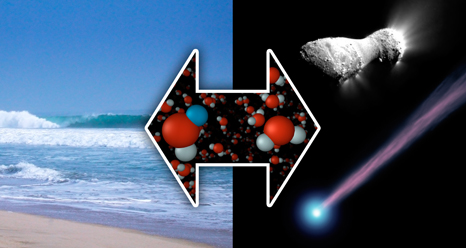
Herschel Space Observatory Provides Clues To Creation of Oceans


The Herschel Mission is a partnership between the European Space Agency and NASA. NASA's contribution was to develop two of the mission's three instruments and supporting data and science analysis.

The Mission has now identified a new cosmic source for the same kind of water that appeared on Earth billions of years ago and created the oceans.   New measurements from the Herschel Space Observatory show that a comet known as "Hartley 2" from the distant Kuiper Belt contains water with the same chemical signature as Earth's oceans.

The Kuiper Belt is a remote region of the solar system, 50 times as far away as the distance between Earth and the sun.  As well as Pluto, the belt has other dwarf planets and numerous comets.

Dariusz Lis, senior research associate in physics at the California Institute of Technology in Pasadena said "Our results with Herschel suggest that comets could have played a major role in bringing vast amounts of water to an early Earth. This finding substantially expands the reservoir of Earth ocean-like water in the solar system to now include icy bodies originating in the Kuiper Belt."


Wednesday, 28 September 2011

Aquarius Mission Provides NASA's First Map of Ocean Salinity


NASA's Aquarius mission has produced its first global map of the salinity, or saltiness, of Earth's ocean surface.

The Aquarius/SAC-D (Satélite de Aplicaciones Científicas) observatory is a collaboration between NASA and Argentina's space agency, and was launched from Vandenberg Air Force Base on June 10.

Commissioning was completed on July 24 and since then Aquarius has been making the first space observations of the concentration of salt  at the ocean surface.  This is providing valuable data for studies of how variations in salinity influence the ocean's deep circulation and defines the path freshwater takes around Earth.

Friday, 26 August 2011

Moon Mission In Final Preparations For September 8th Launch

Image credit: NASA

NASA's Gravity Recovery And Interior Laboratory (GRAIL), mission to study the moon is in final launch preparations for a scheduled September 8th launch onboard a Delta II rocket from Cape Canaveral Air Force Station in Florida.

GRAIL's twin spacecraft are tasked for a nine-month mission to explore the Moon in unprecedented detail. They will determine the structure of the lunar interior from crust to core and advance our understanding of the thermal evolution of the moon.

David Lehman, GRAIL project manager for NASA's Jet Propulsion Laboratory in Pasadena, said "Yesterday's final encapsulation of the spacecraft is an important mission milestone. Our two spacecraft are now sitting comfortably inside the payload fairing which will protect them during ascent. Next time the GRAIL twins will see the light of day they will be about 95 miles up and accelerating."

The spacecraft twins, GRAIL A and B, will fly a circuitous route to lunar orbit taking 3.5 months and covering approximately 2.6 million miles (4.2 million kilometers) for GRAIL-A, and 2.7 million miles (4.3 million kilometers) for GRAIL-B.

In lunar orbit, the spacecraft will transmit radio signals precisely defining the distance between them. Regional gravitational differences on the moon are expected to expand and contract that distance. GRAIL scientists will use these accurate measurements to define the moon's gravity field. The data will allow mission scientists to understand what goes on below the surface of our natural satellite.